Results
Jesters
Other Names: 5th Column Royal Canadian Army Service Corps; Jolly Jesters
Toronto, ON Canada
Founded: 1955
| Repertoire for 1960 |
|---|
| Fools Rush In by Rube Bloom | Johnny Mercer America Swings: The Great Harry James |
| That's Entertainment by Arthur Schwartz | Howard Dietz Judy Garland That's Entertainment |
| The Greatest Show On Earth by Victor Young | Ned Washington |
| Be A Clown by Nacio Herb Brown |
| Man On The Flying Trapeze by Gaston Lyle |
| Sophisticated Lady by Duke Ellington Ulee's Gold - Movie Soundtrack |
| Take the 'A' Train by Billy Strayhorn Duke Ellington 2 CD Set |
| Beer Barrel Polka by Wladimir A Timm The Andrews Sisters |
| Bye Bye Blues by Fred Hamm | Dave Bennett | Bert Lown | Chauncey Gray Les Paul & Mary Ford - All-Time Greatest Hits |
| You'd Be So Nice to Come Home To by Cole Porter Radio Days - Movie Soundtrack |
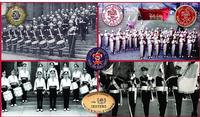
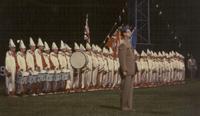
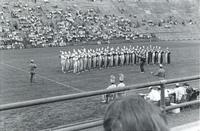
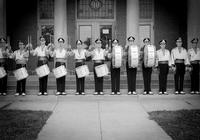
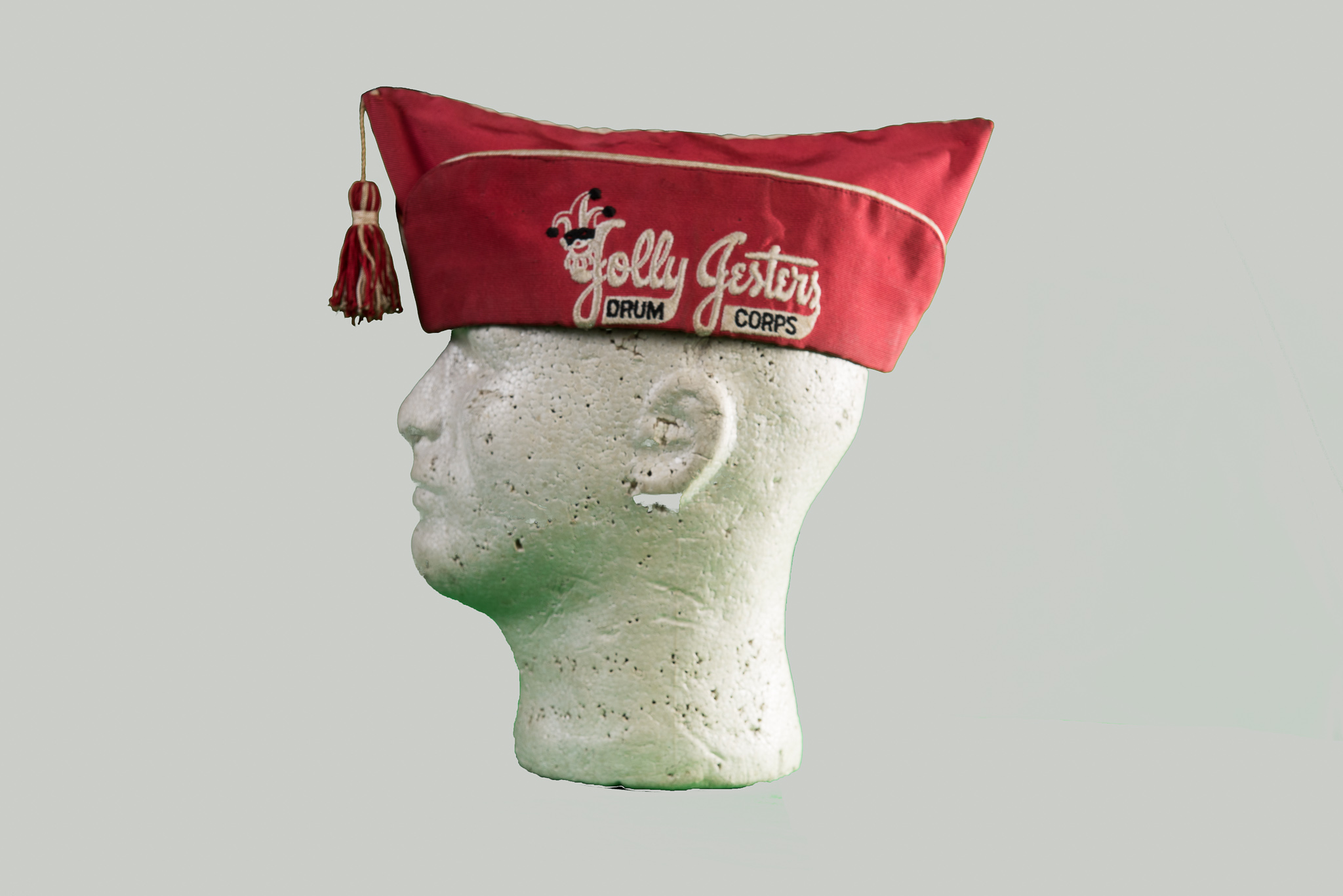
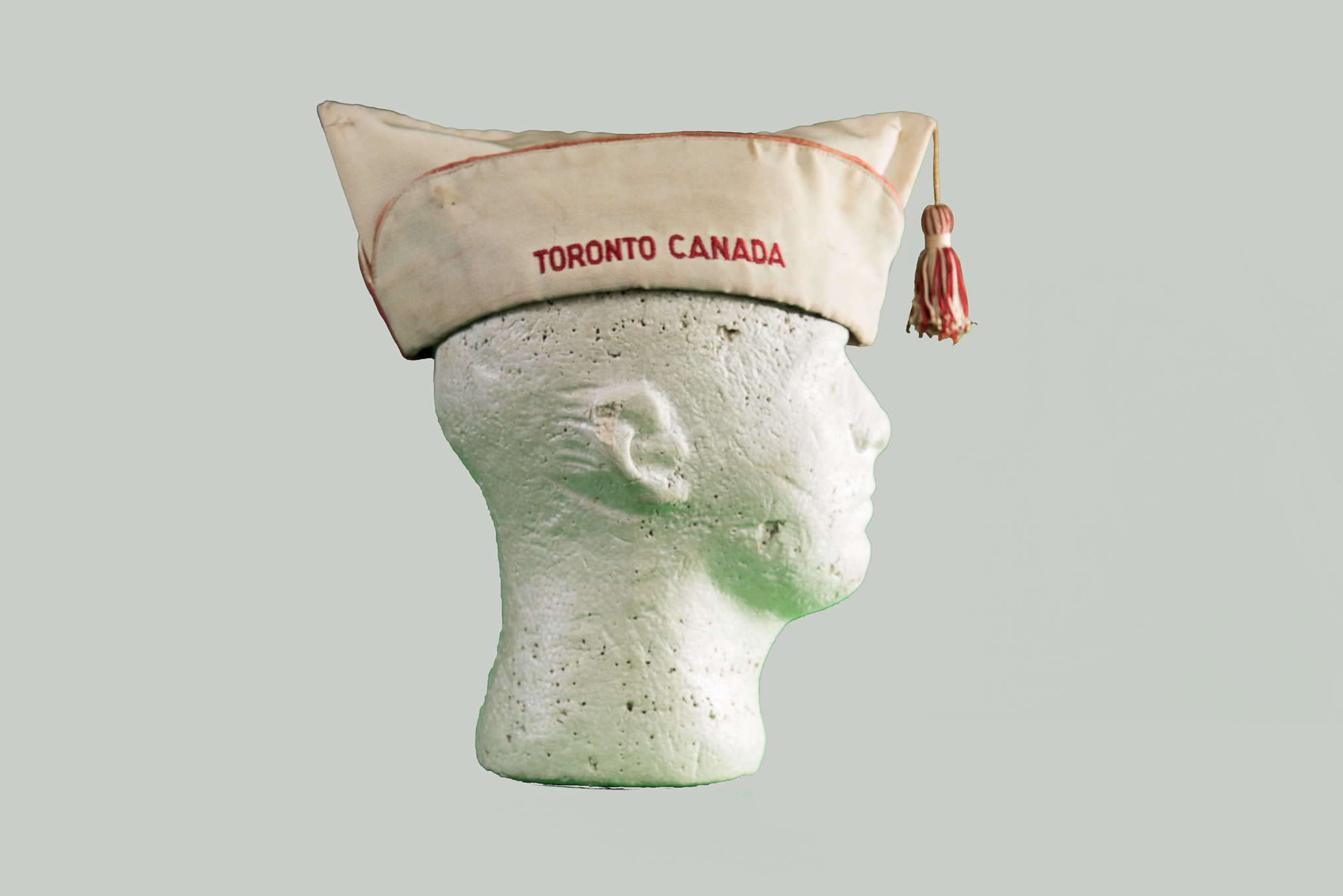
The Jolly Jesters were from Toronto and like many of the early drum and bugle corps, they began as a military band. A group of men in the Army Reserve created a band which became the trumpet and marching unit for the 5th Column, Royal Canadian Army Service Corps (RCASC). The band’s uniform was army dress blues worn with white pith helmets or flat-top hats. They disbanded during the Second World War because band members were on active duty; however, they reformed the band in about 1947 or 1948. The band performed as a parade corps until entering and winning the Canadian Drum Corps Championships (Senior Novice Class) in 1952.
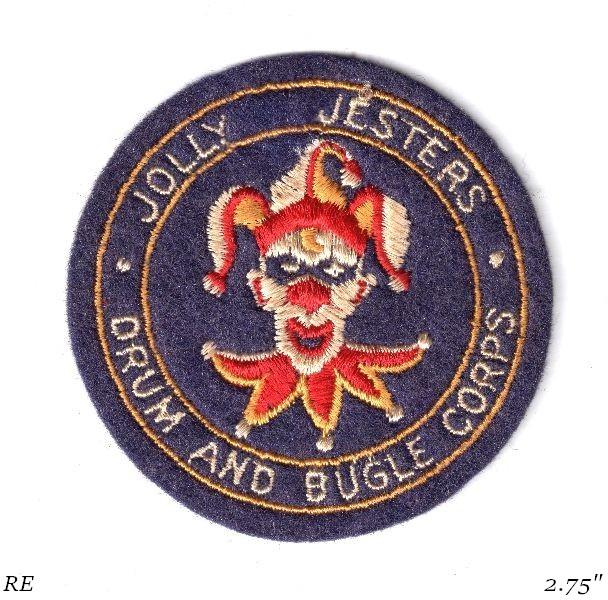
In 1955 the army, responding to a protest by the musicians’ union, forbade the band from performing at a civilian function in Toronto. In response, the band rented clown costumes and performed as a civilian unit. They called themselves “The Jolly Jesters Drum and Bugle Corps.” How did this come about? The transition began around 1954 after Ted Reilly, the band’s director, attended a contest in Batavia. Ted recognized the potential of a drum corps and began putting his efforts into creating the corps’ first full M&M show. In 1955, band members used their own money to purchase a second uniform. They replaced the dark blue military jacket with a sky-blue satin blouse having royal blue cuffs and a royal blue cummerbund. Flat top military hats replaced the pith helmets.
RCASC and the band got along well with RCASC rarely interfering with the band. They wore pith helmets because their new hats were not ready. Ted Reilly, the conductor, is wearing a dark blue top and a sample of the new hat. RCASC treated the band differently from the militia unit. Their expectations of the band were simply to provide a duty bugler, take part in the occasional military parade and march the unit around the armory floor one night a week. In 1955, as an experiment, the Toronto Argonauts Football Club replaced three of their usual halftime shows with a drum corps competition.
Three corps, each corps performing at a different halftime show, would compete for a first-place prize of $1,200. The Argos invited the 5th Column, Royal Canadian Army Service Corps (RCASC) to take part in the competition. Accepting that invitation created problems with both the American Federation of Musicians Union (AFM) and the military. The Toronto Argonauts had already encountered problems with the AFM when, in 1954, they had invited the Second Signals Band, the precursor to the Marching Ambassadors, to perform at two Argo games.
The AFM had lodged a protest with Army Command which forbade Second Signals from performing. Another story says that the 48th Highlanders, who had performed at Argonaut half time shows for a long time, complained to the union about the money they were losing. Either way, the AFM was not happy. The Argo competition re-ignited the battle. A newspaper reporter wrote “Walter Murdoch, of the Musicians Union, accusing the Argonaut football club of being ‘plain cheap’, charged the $1,200 prize money was only a fraction of what the club would have to pay for professional musicians”.
The AFM responded to the Argo competition by blacklisting all trumpet and bugle bands in Ontario (both Junior and Senior). A newspaper report from 1957 stated that the union and bands had reached a resolution; however, the blacklisting of drum corps was still active in the mid-1960s. In 1965 the organizers of the Easter Seals Telethon, a “Cross- Canada” televised fund-raiser, invited the Toronto Optimists to perform. When the corps agreed, the response from the union was swift and clear. The union said that, if the Optimists performed, they would ban union musicians from performing in the telethon.
The Optimist chose the only reasonable option and withdrew from performing during the telethon. The union was not the only problem facing the band. Army regulations prohibited active service and militia bands from replacing union bands or taking part in competitions for fees. The RCASC said that Army Central Command had issued an order prohibiting the band from participating in the Argos competition as an army unit; however, the band members very much wanted to compete. The clause “as an army unit” was their loophole. Band members rented circus clown costumes then competed under the name “The Jolly Jesters”.
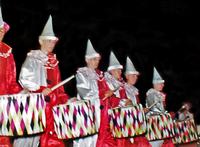
You might wonder why they chose clown costumes. The corps needed to rent 45 similar costumes and the only suitable option that was available at Malabar, Toronto’s costume emporium, was clown costumes. On the surface they were an unknown band; however, the bodies under those clown costumes were the members of the RCASC band. So, how did they do? In 3rd place was the Merritton Grenadiers, preceded by the 2nd Signals while the Jolly Jesters won. They marched home with the top prize money in their very first competition! Their performance was a big hit with both spectators and band members.
The next year, in 1956, the corps received its first invitation to a major American contest. Dave Wood remembers: “While everyone agreed with the clown costume at the Argo game to do it for an American audience at a regular Drum Corps show took a hard sell by Ted”. With all members on board the corps, for the second and final time, rented clown costumes. In August 1956, the Jolly Jesters performed at the Mardi Gras of Champions in Albany and drew tremendous applause. The overwhelming positive response to the clown costumes made it easy to keep the Jester theme so band members opted to continue competing under the name “The Jolly Jesters”.
The drum corps world had gained a new competitor! For those with more military persuasion, corps members were still in the army and had army dress blues. Over the winter Ted designed new uniforms, chose new theme music and created a new show. In 1957, the corps performed in matching Red and White clown costumes designed by Ted and made for them by Malabar. The left side of these new costumes was red, and the right side was white. With the new uniforms, the corps would flash red and white in sequence as they marched and turned. On the field Ted Reilly, the corps director, wore a tramp costume complete with tails, patches and a top hat. The corps’ drum major, Ted Higgins, dressed as a Court Jester, led the unit to a 3rd place finish in the very first Canadian Nationals “Senior A” championships.
In later years, Ted Reilly wore the Court Jester costume. Dave Wood remembers the corps on the starting line playing a fanfare, “I’m forever blowing bubbles, pretty bubbles in the air”, before releasing colored helium-filled balloons then stepping off to “Be A Clown.” The crowd thought it was a great way to open their show! Tom Mellors wrote this: “I tell people that the clown outfits were ideal for coping with weather. For performances in the hot summer, we only needed underpants under the clown suits. In cold weather, heavy coats and long johns ruled the day. We all looked the same in the clown suits, and no-one ever noticed any difference. In looking at today’s modern drum corps, I think the Jolly Jesters, with their show and ‘costumes’, were ahead of their time.”
Dave Shano recollects his part in the show: “I wasn’t good enough to play. My only appearance was to wave my hand anxiously at Ted Reilly - I had to go to the bathroom BAD. He waved me off the field; and the Corps started the show. After an appropriate time, I came back on and squatted on the field until Ted chased me to two or three different spots so that I didn’t impede the show. That was my claim to fame. Of course, the kids got a laugh.” In terms of repertoire the Jolly Jesters selection of music was eclectic, ranging from circus-related songs such as “Pagliacci”, “Man On The Flying Trapeze”, “Be A Clown” and “Another Opening, Another Show” to marches like “Semper Fidelis” all the way to jazz numbers which included “Sophisticated Lady” and “Take the ‘A’ Train”. From 1958 to 1960, the corps was a perennial finalist in the Canadian “Senior A” championships, placing 2nd in 1958, 3rd in 1959 & 4th in 1960.
Dave Shano remembers a Judge saying, “You’ll never win as clowns”. Other people had made similar comments. Corps members began wondering whether they would get higher scores in competition if they looked more like a “traditional” drum corps. Many corps members felt that a change in both their uniform and style was the path to take. During 1960, the corps usually performed in their clown costumes, but they sometimes wore the light blue silk tops that they had purchased years earlier. By the end of the 1960 season, the Jolly Jesters performed in 24 contests, 17 of them in the United States. In 1961, several members had moved on as the remaining membersncreated a new corps called “The Jesters”, leaving the mystique surrounding the “Jolly Jesters” to drum corps history with their colorful costumes and crowd-pleasing performances.
Band members had accumulated their “Army Pay” and used that money to purchase uniforms and instruments. The Jesters inherited this equipment since the Jolly Jesters, not the military, had purchased it. Dave Wood said “with the blue shirts we wore the dark blue army pants with the double white stripe. Never gave them back.” When competing during 1961, the Jesters wore the sky-blue silk tops that the Jolly Jesters had purchased, on their way to another 4th place finish in the Canadian Nationals “A” division finals. In 1962, the Jesters purchased new, dark blue uniforms, improving to 2nd position in the Canadian championships for only the second time since 1958. In their last year of competition, the corps placed 3rd in the 1963 Canadian Nationals.
In 1964, the Jesters merged with the Hamilton Viscounts to create the Canadian Commanders.
Bob Carell (Main author); Dave Shano, Dave Wood, Jim Patten, Ann White, Lorne Ferrazzutti and Tom Mellors, together with Steve Vickers and Drum Corps World, who supplied photos and information for this article. Toronto Optimists Alumni website; DCW, 8.31.03, p. 32; Ron Allard, RAMD, 5/25/2000; Ed Law December 2006
-
1930 1 scores Final show in DCX Archives August 6, 1930 Rochester NY placed 3 with a score of 78.250
-
1956 1 scores Final show in DCX Archives August 16, 1956 Albany NY placed 5 with a score of 67.950
-
1957 1 scores Final show in DCX Archives September 7, 1957 Canadian Nationals Championship Galt ONT Canada placed 3 with a score of 83.430
-
1958 2 scores Final show in DCX Archives September 13, 1958 Canadian Nationals Championship Galt ONT Canada placed 2 with a score of 84.700
-
1959 1 scores Final show in DCX Archives September 12, 1959 Canadian Nationals Championship Galt ONT Canada placed 3 with a score of 81.410
-
1960 5 scores Final show in DCX Archives September 10, 1960 Canadian Nationals Championship Hamilton ONT Canada placed 4 with a score of 84.275
-
1961 4 scores Final show in DCX Archives September 9, 1961 Canadian Nationals Championship Waterloo ONT Canada placed 4 with a score of 78.300
-
1962 9 scores Final show in DCX Archives October 7, 1962 Toronto ONT placed 2 with a score of 80.900
-
1963 8 scores Final show in DCX Archives September 7, 1963 Canadian Nationals Championship Waterloo ONT Canada placed 3 with a score of 82.750
Members (1)
| Member Name | Section | Years Involved | |
|---|---|---|---|
| Tarasco, Vince | Baritone | 1956 to 1958 |